

Melliodora Tour – September
The tour lead by David Holmgren of his property in Daylesford demonstrated to me that Permaculture is a system of care, attention and connection to the place and the people that inhabit it. Unlike other approaches that I have witnessed where the ‘low maintenance’ and ‘minimum care’ approach to a self-sustaining system has been made, David Holmgren demonstrated that the relationship with the property is one born out of a passion and immaculate attention to detail – while at the same time down to earth and practical in every sense.
Emphasis was placed on the importance of soil condition, and David offered various approaches for re-balancing soil structure for optimal mineral balance. At the end of the day – if the soil contains the correct balance of elements for the plant – produce such as pumpkin should keep through to mid Summer. I find this particularly interesting given the finding that are being made into the cause of Alzheimer’s being that of mineral inbalance, whereby the brain is becoming “rusty” from toxins.
David spoke about allowing a design to develop organically. I have experience this myself where – the garden will slowly reveal to me what will work and what will not work. It is not a matter of logic or careful planning (although these or course are recommended) so much as observation over time, trial and error. Again it returns to creating a relationship – spending time with the space and its “quirks”.
Having cultivated some artichokes recently I was thrilled to see that David has used this plant as the under-story for fruit trees. As the artichoke is active in Winter – and is busy working away while the fruit tree above is dormant and free of leaves to allow plenty of sunlight through.
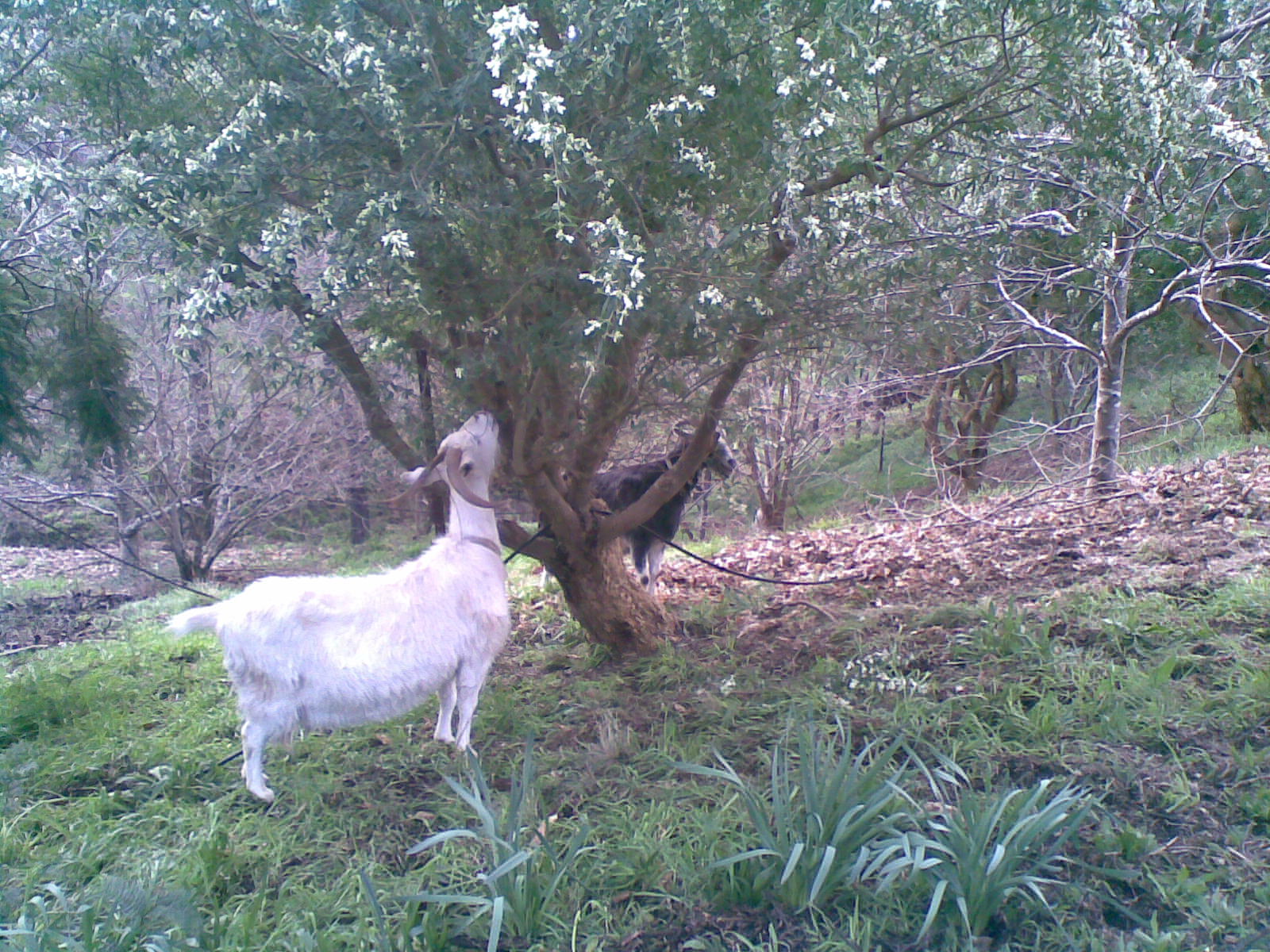
The importance of tree selection for fodder (mostly for the goats who put on a real show) and also to support sun catchment was discussed. No pines or gum trees were planted on the property – but were restricted to the very outer border and are likely to be cut for fire wood. With the exception of the Bunya Bunya pine which is harvested (well it drops huge pine cones) for the pine nuts. Deciduous trees, while not native were selected as “settlement friendly”. Trees recommended included oak, willow, blackwood and black walnut. Perriwinkles along the boundaries were chosen as they are shade tolerant, soil improvers and most important fire retardants. These were planted along the river bank along with the cricket bat willow which had been cut and sent off to make … cricket bats!
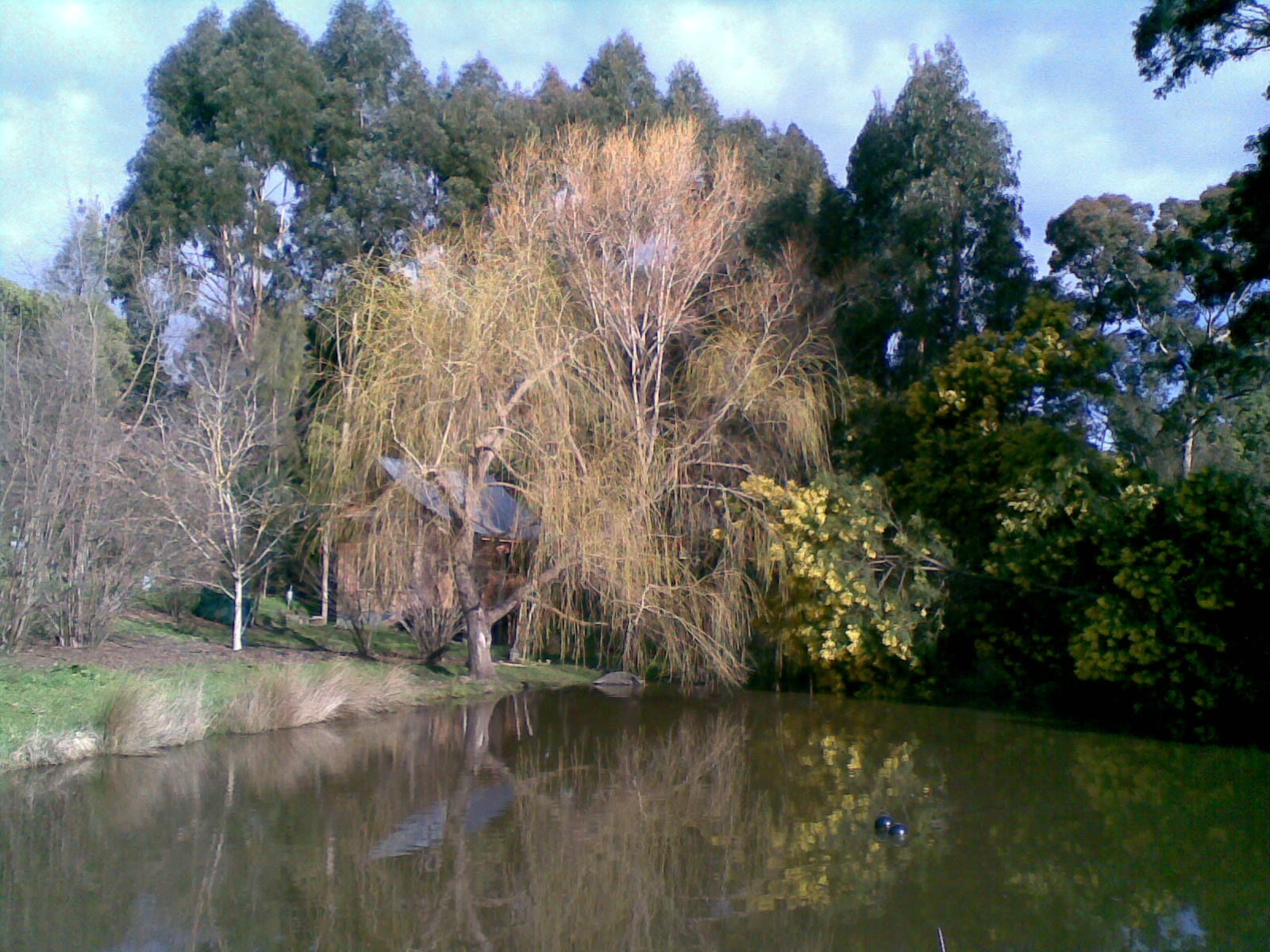
The willow, which has been persecuted as a non-native, is used to create a sound rootmat along the river edge and similar to the Mellaluka in the Northern Territory is used for re-building hydrology (catching sediment and improving soil structure).
Closer to home (Zone 2-3) always the preference is towards food and fodder trees. Walnut and Hazelnuts were inter-planted with oak and tall, well-pruned Casuarina. David discussed that you shouldn’t over do bio-mass and it was clear that between the goats and his constant pruning that every tree on the property was contributing, rather than detracting from the system. Also once they reached maturity and if they were taking too much sunlight, space or water they would be cut for their wood. Walnut trees for example pull a lot of nutrients from the system and can grow as fast as gum trees if the mineral balance of the soil is right. The dam at the bottom of the property acted as a sun catcher for the main orchid, reflecting the late afternoon rays up the slope all towards the home. Even the slope was considered in the design – as to where the choockies would dig in order to bring, for example, the oak leafs down of the slope and pile up for creating humus.
It was a lovely design – not overwhelming, but intrincsic with its detail. Most importantly it worked.
Highlight of the property would have to the Pear Tree. I would never have identified it as a Pear – it was huge. Planted some time during the gold rush and nearby the remains of an old homestead. The ley lines of the property meet at a conjuction just infront of the tree and is said to be a wonderful place for healing! Well the entire property resonated with a healing vibration. But this point was certainly a lovely place to stand and take it all in!
 Soil to Stars