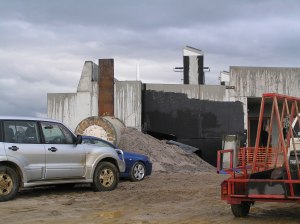
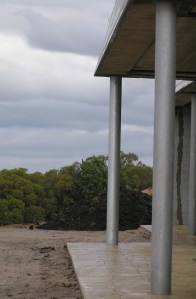
This weekend took me up a mountain to see a house build into a mountain. The full submersion of the roof appears to have not been completed and the owners were yet to move in, but the pizza oven was fired up and people came to admire, more than anything the views at the top of the rather slippery drive way. It gave me a sense of what this design which, I have admired for many years actually feels like. Away from the screen of Grand Designs I was surprised by how claustrophobic the back rooms felt, despite sky lights and if money permitted would have gone with a wrap around and more frontal aspects. However such great admiration for this couple who have spent the last 25 years planning and are now living their dream.
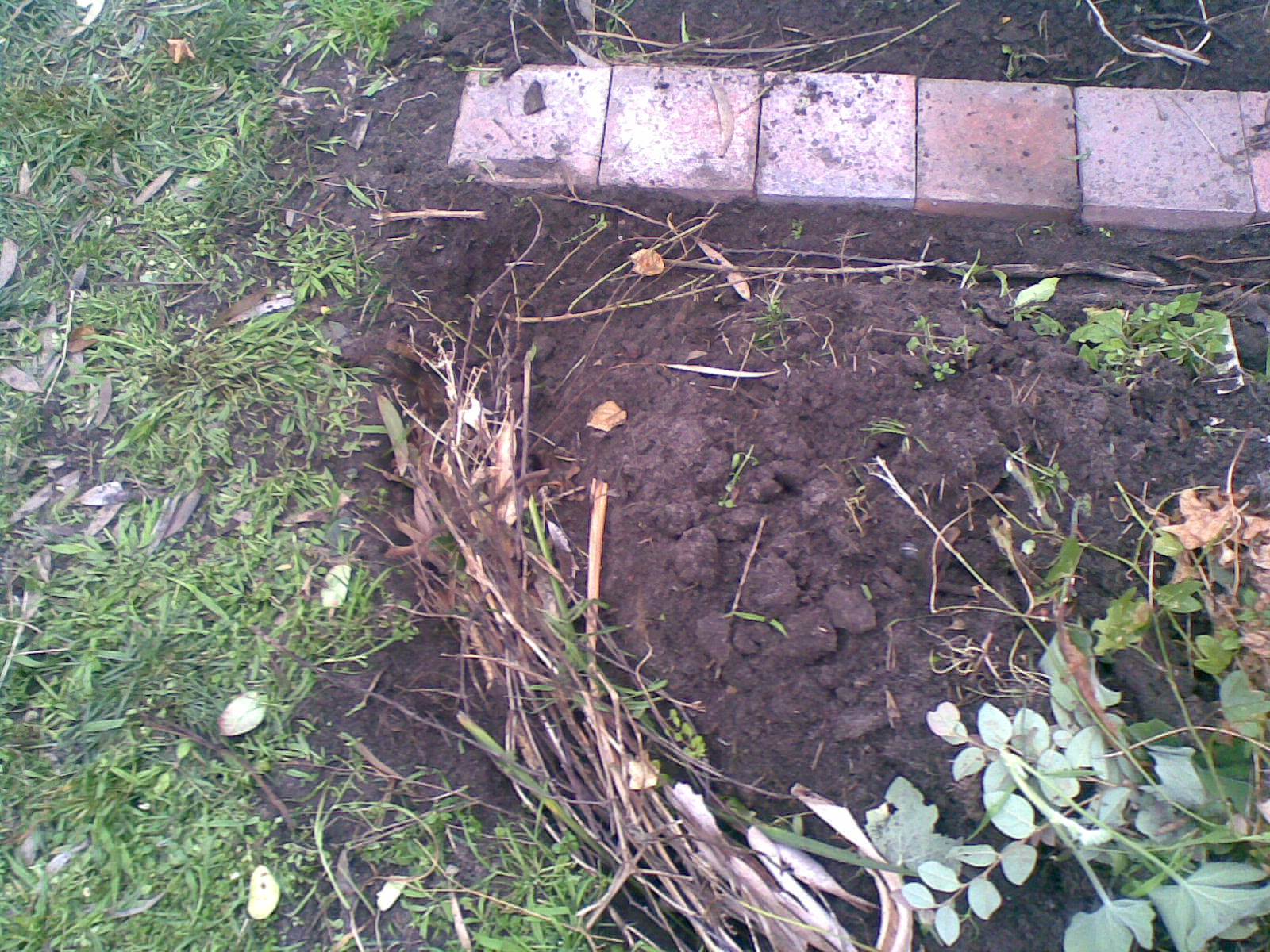
Well a weekend of no rain – meant getting the roses pruned and also finishing off preparations for the front key hole garden! I am determined to have produce in it by spring and the soil from the compost and piling cutting is looking great! After seeing the food forest at Southern Cross Permaculture Institute I got thinking about natural edging methods. Listening to Rick speak about the food source created by dead trees and hard cuttings I have decided to use ALL of the woody prunings that have piled up in the back garden as an edge. I am also going to use this method for the back keyhole garden also. So to make this work – I have edged the boundaries to make a ditch and cut the prunings into lengths to be stacked continuously around the circle and also around the edge of the ‘keyhole’ beside the pavers. This provides a use for a huge amount of waste – which would otherwise end up on the nature strip and will hopefully house helpful insects and healthy bacterias. I am yet to discover how well it will keep the weeds away – but if it is thickly stacked enough with plenty of small mixed in with large cuttings – hopefully it will work well. It will also work as a water catching mote when it rains! I am rather thrilled with this as I haven’t seen it anywhere else – but like all good ideas – probably it has been done before ! Most of all it just looks lovely – like a big nest in the middle of my garden waiting for life!
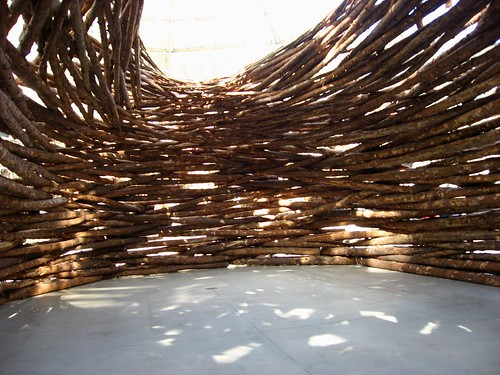
This brings to mind on of my favorite artists – Andy Goldsworthy and his use of ‘nesting’ spaces:
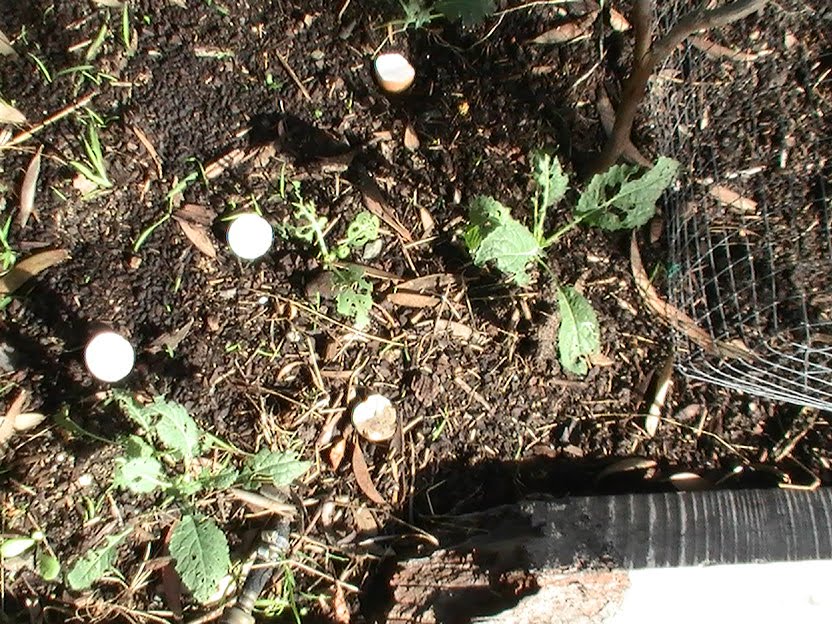
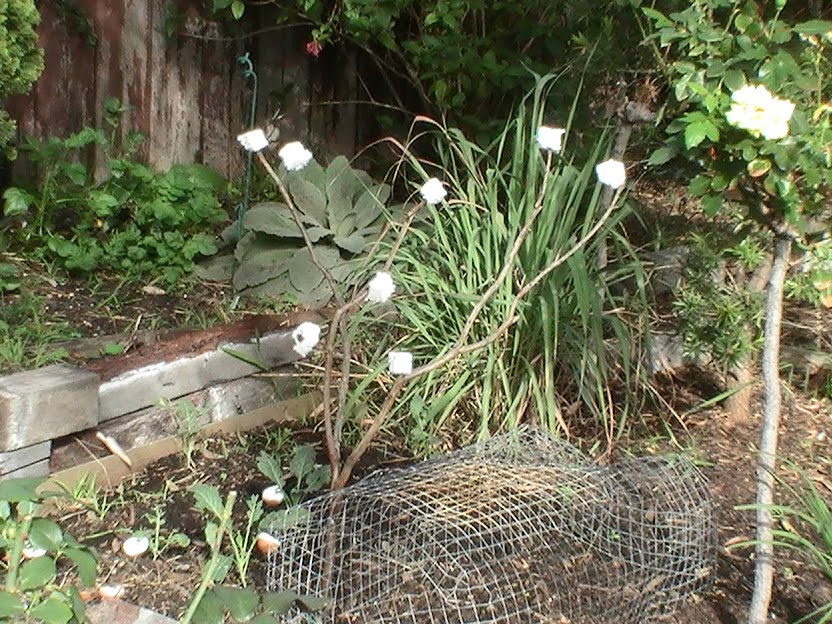
Recently at BAAG (Buleen Art and Garden) I learnt that if you tie white plastic bags to sticks the cabbage butterfly take it for another butterfly and will leave the area alone as they are territorial. Mimi has adopted this method with open egg shells which I have implemented. Then yesterday walking the dog – I noticed that a large piece of polystyrene foam had blown up on my front garden. I put it straight in the bin and continued on my walk. Just a few paces in – I thought about how very white the foam was. Perfect for deterring cabbage butterflies – further down the walk I came across a lovely branch and decided it would make a perfect polystyrene tree. So with the tree and egg shells in place hopefully the catter-pillers will be kept at bay. This morning was the first morning that I have gone out and not had to pick any off the kale seedlings!
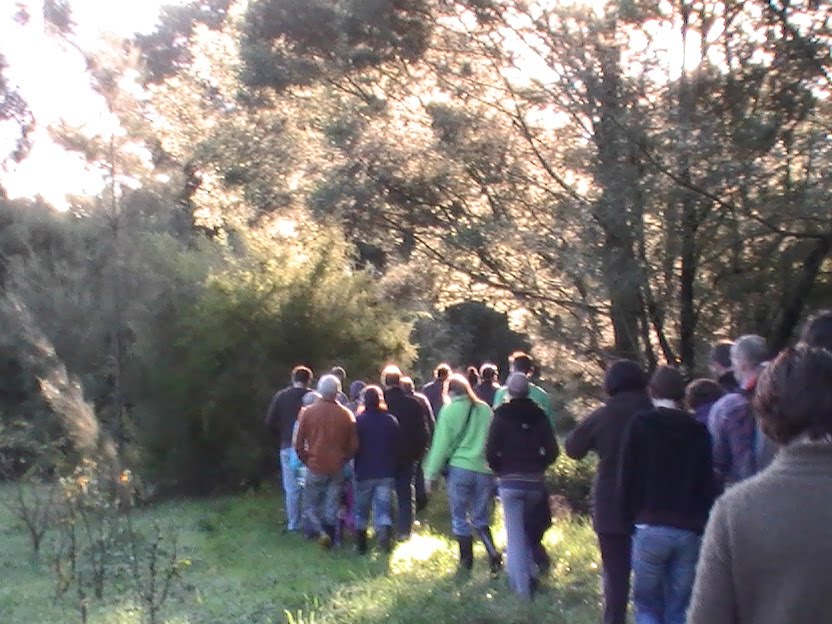
Queens Birthday weekend was spent at the Souther Cross Permaculture Institute taking the tour with Rick. It was fairly overwhelming to stand on the land – knowing that it had been flat grazing land just 16 or so years ago and that every tree planted had been done so by Rick and Naomi. The use of water as a Sun Catcher was the most impressive element that I came away with and have since been paying more attention to the reflection of water in even small things around the garden like bird baths. Photos and video to come!
A visit on the weekend to the Ashwood Permaculture Project Garden highlighted once again the many variations of what a Permaculture garden is.
With an emphasis on education and community – this property has evolved from an empty block to a food bowl and outdoor class room for the high school and local volunteers.
Because it is a vision for a community – the design is fluid. A series of mandalas have been established and the choock are rotated around this living mandala. A series of swales has been established, as it is quite a sloped block, in the form of dug in bath tubs.
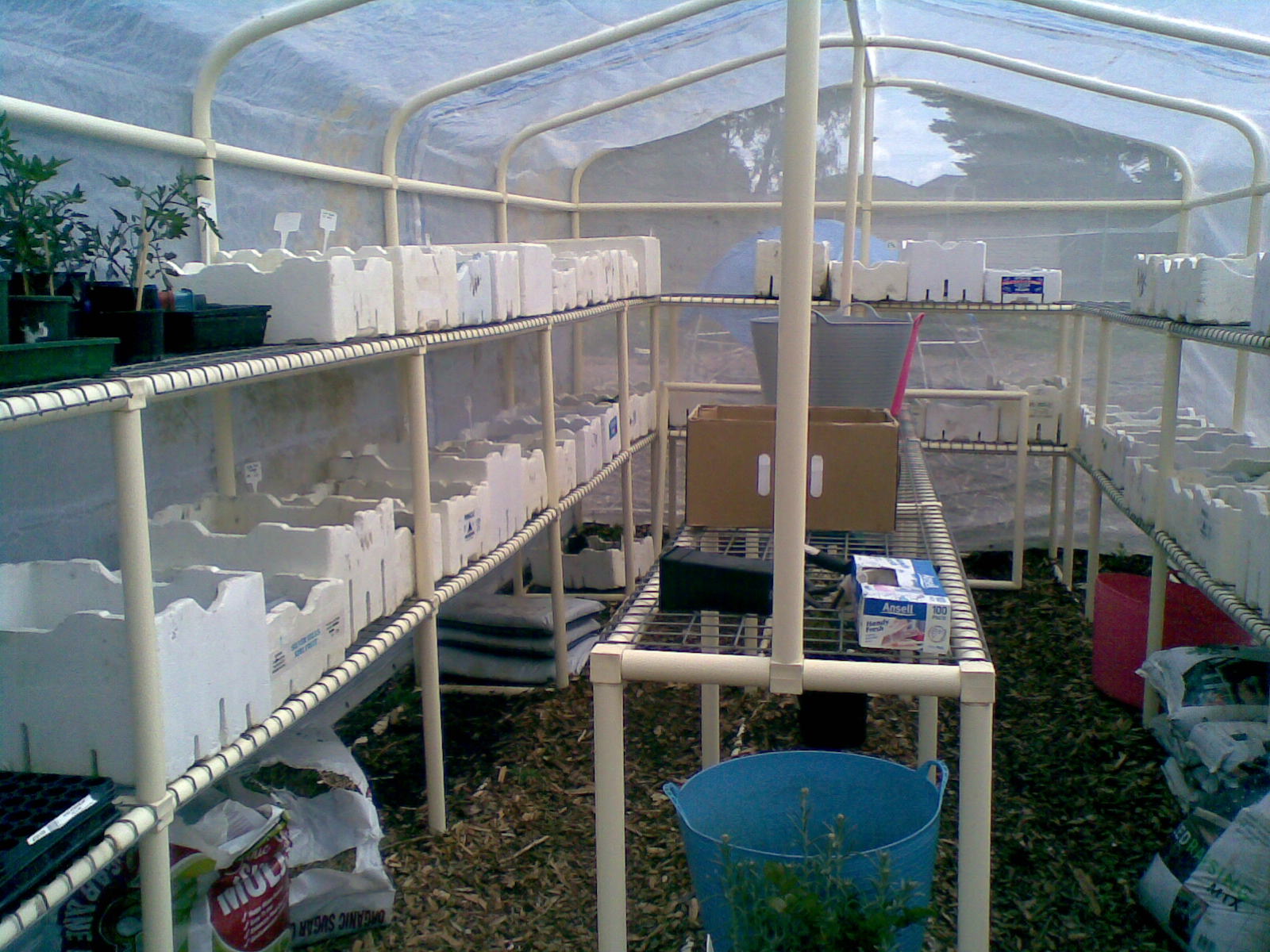
I found the hot house the most impressive aspect. With a very well organised array of seedlings – herbs and edibles – which we chose from to plant out one of the circles on the block.
It was completely different to the two rural permaculture properties I have seen and showed me again how the principles can be taken on and interpreted by an individual to suit their vision.
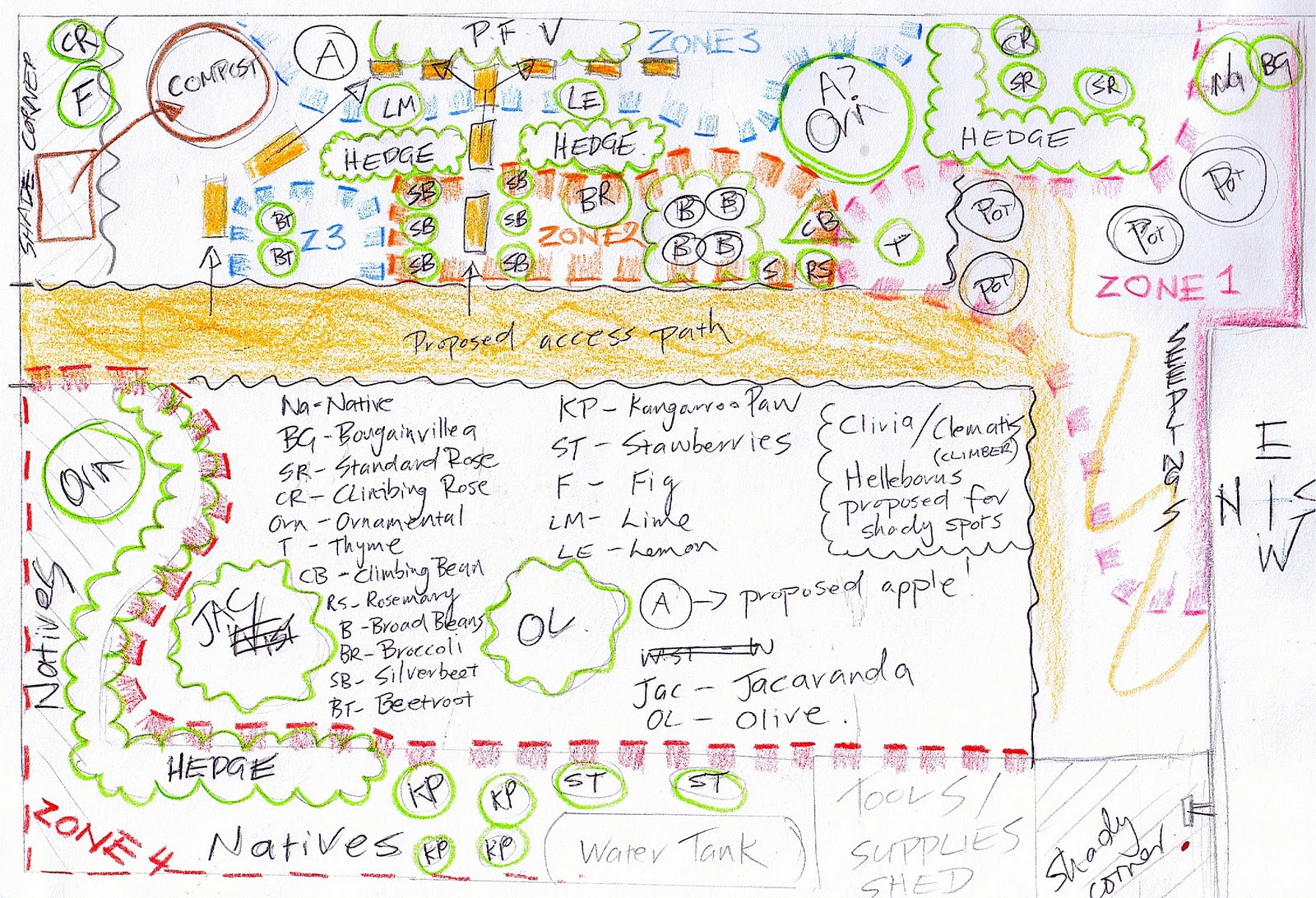
Zone 3: Slow Growing Annual root veg /perennial fruit / Veg
Rhubarb/Asparagus Tomatoes (Zone 2 or 3) Cucumber Zuchinni Eggplant Silverbeet Corn (plant several in close proximity for cross pollination)
Beetroot Parsnip
Potatoes Garlic Leeks Onions Turnip
Zone 4 Ornamentals/Natives
COMPOST TIPS Compost Bin – Back Slightly Sunnier Spot Infront of Fig (where bin was) – is now a space for drying cuttings (before adding to compost) Remember 1:1 Ratio Wet:Dry Wet = veg/fruit scraps Dry = Clippings – no bigger than tips of branches + dry leaves / dry grass clippings / dry hedge trimmings (place clippings beside the bin for a couple of weeks (or days in Summer) to dry before adding to the compost – unless autumn leaves – they can go straight in. No root balls (too woody) and no big branches Newspaper (scrunched up) is an alternative when no clippings/leaves are available Dry has been the missing ingredient (it is like a sandwhich where the dry layer provides aeration for the breakdown of the wet)
SOIL HEALTH
Air in the soil (like in the compost was the missing ingredient) The way to create aerated soil is to layer compost – with mulch and manure (3-6 alternate layers) ending with a mulch of either whole (not crushed) sheep manure/lucerne or sugar cane mulch. I have dug in the compost to begin with as it was not well broken down (but well enough – you will find some egg shells about which take the longest – but are a good source of calcium). On top of this was placed crushed sheep manure, organic pellet form (slow release) fertiliser, blood and bone, sugar cane mulch followed by whole sheep manure (again slow release). You can not plant seeds in this ‘no dig’ style soil structure yet. If you want to plant straight from seed then make a small whole and fill it with seed raising mix (or grainier soil from deeper below once the layers have broken down), otherwise plant seedlings straight through the layers.
An initial planting of legumes would be great for the new areas (Zone 3 – where the tomatoes are planned) you allow them to get almost to full season (just seeding/flowering) or just before and then cut them (with a dutch hoe for example) and dig them into the soil. This can also be done at the end of the season – before planting the next crop. Never plant tomatoes in the same spot two seasons in a row (a bacteria infection tends to occur)… try crop rotating root veg with leafy veg the following season and continue to alternative in this way each year.
Strong smelling herbs – garlic chives/peppermint varieties are great around veggie crops and also your roses to stop disease and pests.
Comfrey/Yarrow around the fig would be ideal – the tap root of the comfrey brings valuable nutrients up to the surface and both can be added to the compost to aid break – down. Stinging nettle – if you can stand it is also great for this.
Nasturtium / Peppermint Pelargonium are non-inavisve ground cover ( and great weed control) as are strawberries.
Hedging can be achieved with edibles such as blue berries (mulch well and water often) if you want an alternative to the box hedge.
I would consider planting another passionfruit vine to support the one already in – and buy an organic beef liver from the butcher and dig it in – just below the root ball. Passionfruit need plenty of nutrients and this is an old and tested method (again only if it sits OK with you!)
I would think about cutting the lawn (1/2 meter circumference) around the Wisteria and Olive to allow watering and feeding of the soil above the root zone. You could also consider planting some edibles around the drip line such as Artichokes. Artichokes would also look very uniform (and are Perennial) for the front under the weeping ornamental where the pumpkins are planned.
In the shady cornersClivia/Clematis/hellebores would all work as well.
Recently I came across the DVD “Reconnecting to Nature though Spiritual Permaculture”. It documents a conference in Hawaii whose guest speaker was Dr Leonid Sharashkin, translator of Anastasia which I had read a couple of years ago. The DVD has been playing on my mind after watching it. It asks us to re-introduce consciousness into design and suggests that design is nothing more than an expression of the conscious state we are in at any given moment. Gardening for food is advocated as much more than a practical solution – it is a Spiritual practice of healing both our selves and our environment.
This is particularly pertinent as the garden for “Permaculture in Suburbia” is within the setting of a Yoga School. This weekend I was working on the Spiral Meditation Garden. I have planted the two new grafted apples from Toora Heritage Pear Farm Grafting Day – given that there has been soo much rain I was drawn to planting and transplanting in the moments when the sun did come out.
The Spiral seems to have a life of its own and I have enjoyed the experience of stepping back and allowing it to take form around me. I was looking today at the Roses which we had transplanted last winter into this site which has now become the Spiral. The move of the roses was made out of necessity – there was not enough rain and we wanted to dedicate the front garden beds to food production as they receive the most water. The roses were given strict instruction – you’ve just got to make good of what you got – they were not watered particularly much but have thrived and now make a gorgeous setting for the meditation spiral walk. What I enjoyed as I looked at them today was the sense of having not planned – but ended up with exactly what I would have wanted!





 Soil to Stars